
In 2027, AI will be assumed in your social workflow, and the platforms will reward the posts that still carry a real person's point of view. That is a forecast, built on announced changes at LinkedIn and Instagram and on survey data from HubSpot, not a promise.
The practical change for a small B2B team is simple. Drafting gets cheap for everyone, so the edge moves to what you know, who you are and how consistently you show up. This guide lays out what has been announced, what it points to for 2027, and a weekly operating plan for SaaS founders, MSP and cloud partner leaders, professional firms and anyone running founder-led LinkedIn sales.
What is already true before 2027 starts?
These are facts as of November 23, 2026. Everything in the next section builds on them.
What changes should you plan for in 2027?
Each forecast below is tied to one of the announcements above. The reasoning is mine. The dates and numbers are the sources'.
1. AI drafting becomes a baseline, not an advantage
If 94% of marketers already use AI, using it stops being a differentiator. Forecast: by 2027 your buyers will assume any B2B feed is partly machine-drafted, so the posts that win will be the ones that carry something a model cannot produce, such as a client story, a number from your own work or a decision you made.
2. Feed ranking gets better at reading meaning, so generic posts lose
LinkedIn says its new ranking systems better understand what a post is actually about. Forecast: a post that restates common advice has less to differentiate it from the thousands like it, and a post with a specific claim in your niche has more. LinkedIn also said it wants fewer posts "designed purely to game distribution."
3. Automation that fakes engagement becomes a liability
LinkedIn named comment automation, engagement pods and unauthorized third-party tools as targets. Forecast: any workflow that auto-comments or auto-engages on your behalf carries account risk in 2027. Use AI for drafting and planning, and do the commenting yourself. This matters most for founder-led sales, where your name is the asset.
4. Disclosure and labeling spread
Instagram's label is limited to profiles featuring an AI-generated person today, and Social Media Today reports Instagram plans to add more labels to AI content. Forecast: expect more platform labels and more reader skepticism in 2027. A business that is open about using AI for drafting, while keeping a named human accountable for every post, is on safer ground than one hiding it. This is a forecast about direction, not a rule that exists on LinkedIn today.
5. Trusted voices carry more of the B2B buying process
In LinkedIn's 2026 Global B2B Marketing Outlook (YouGov, 1,299 B2B marketers), 82% of B2B marketers who work with creators agreed that influencer campaigns are essential to deliver measurable ROI. The same release says 56% of B2B buyers who use creators rely on their input during the final stage of the buying process. The survey comes from a platform that sells creator products, so read it as directional. Forecast: your own founder or partner voice is the cheapest version of a trusted voice, and more of your pipeline will start there.
6. Proof of authenticity matters beyond social
LinkedIn reported that 64% of US talent acquisition professionals say it is becoming harder to know who to trust and what is real when assessing candidates, in its Hiring Assistant 2 announcement. That is hiring, not marketing, but the same trust gap applies to vendor selection. Forecast: verifiable specifics (named clients, real screenshots, dated results) will do more work in 2027 than polish.
How does each announcement turn into a move for your team?
This is the part most guides skip. Each card ties a source to a prediction and a move a small team can make this quarter.
Forecasts are predictions, not facts. Sources and dates are linked in the section above.
What stays the same in 2027?
Three things do not change on any announced roadmap:
On that last point, Sprout Social’s 2026 content strategy report advises using AI to power audience insights and process efficiency, not to replace human taste. That report covers consumers across all brands, so treat it as a signal and not a B2B benchmark.
What does one week of AI-assisted posting look like?
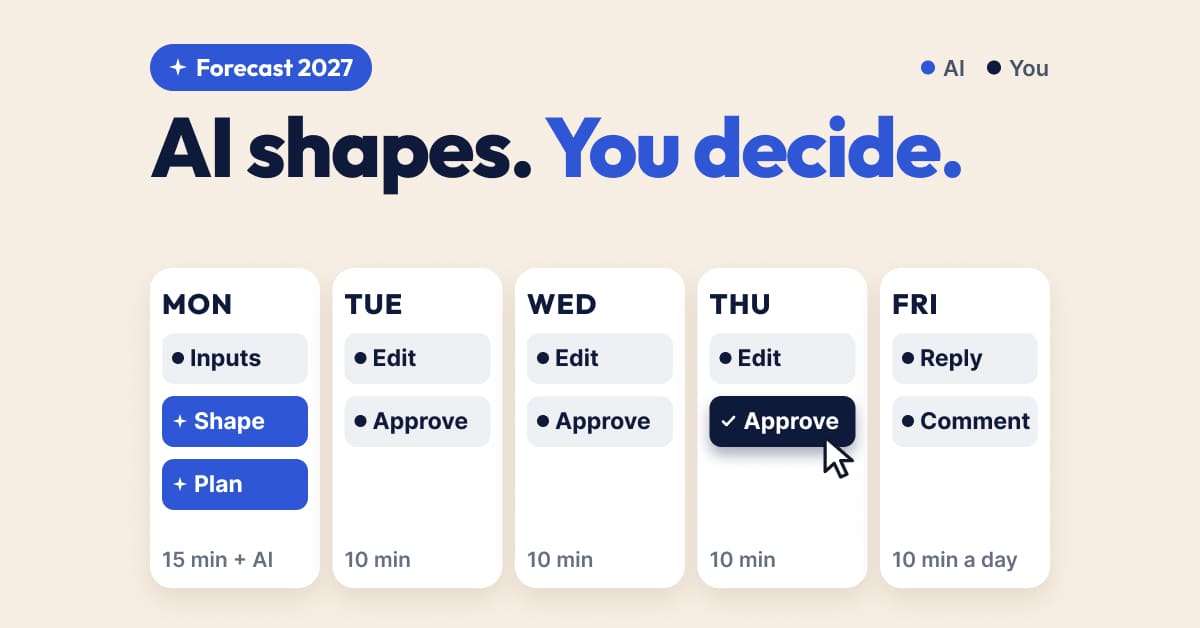
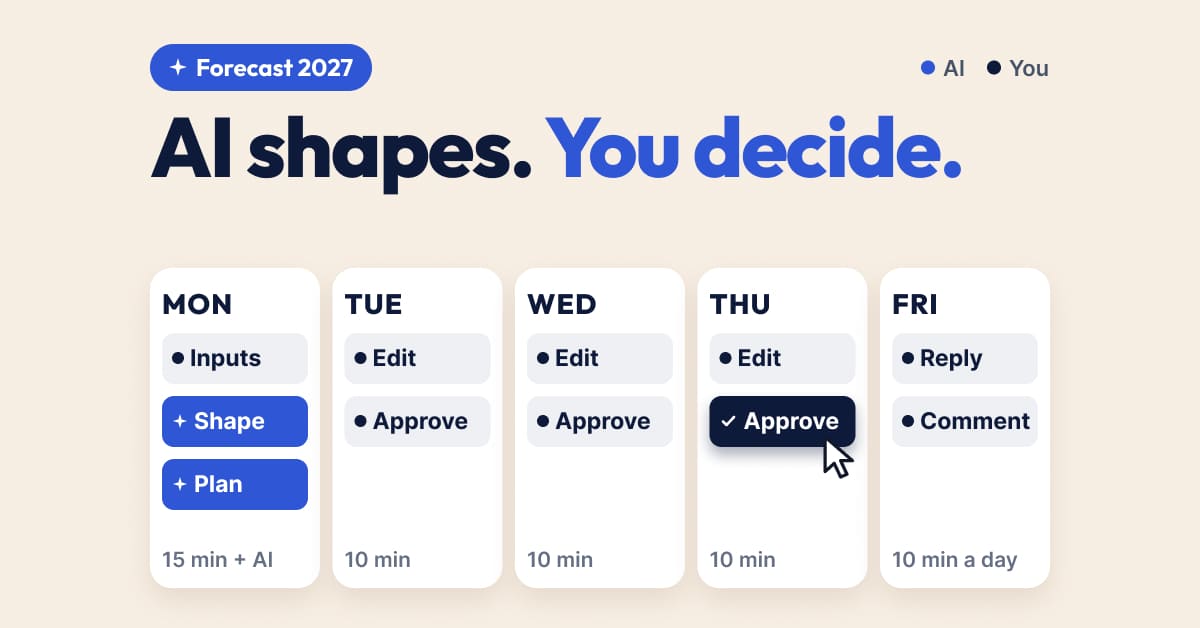
This is an illustration, not data from any customer. An MSP owner posts three times a week on LinkedIn to reach IT directors at 50 to 300 person companies.
The split is the point. AI handles shaping and planning. You provide the facts, the judgment and the conversation. That division holds up under every forecast above.
What should a small team’s AI use policy say?
Copy this one-page template into a doc and fill it in this week. It keeps a team consistent as platform rules change.
Where does SocialPost.ai fit?
If the weekly plan above is the part that keeps slipping, that is the gap SocialPost.ai is built for. It drafts on-brand posts for you each week, you review and approve them, and nothing goes live until you approve it. Your facts and your approval stay with you. For more on keeping drafts in your own voice, see how to make AI LinkedIn posts sound like you. For the wider platform picture, read Social Media Trends 2027 for B2B Companies and LinkedIn trends for 2027. If scheduling is your bottleneck, start with how to schedule posts on LinkedIn.
Frequently asked questions
Will AI replace social media managers in 2027?
None of the sources in this guide supports that. HubSpot found 94% of marketers already use AI as part of their workflow, and the survey data shows AI changing tasks, not removing the role. Expect smaller teams producing more drafts, with more weight on editing and judgment. This is a forecast.
Does LinkedIn penalize AI-written posts?
LinkedIn has not announced a penalty for AI-assisted writing. Its March 2026 update targets comment automation, engagement pods, unauthorized third-party tools and engagement bait. Recycled, repetitive and low-substance posts are what it says it wants to show less of.
Should I disclose that I use AI for social posts?
No LinkedIn rule requires it today. Instagram limits the reach of profiles that feature an AI-generated person without its AI-generated profile label, though creators who only use AI tools do not need it, and Instagram plans to add more AI labels. Being open about AI drafting with a named human approving each post is the lower-risk position for 2027.
What should a small B2B team automate first?
Drafting and planning. HubSpot's respondents mostly use AI for ideation and captions, and only 13.54% use it for social listening and trend monitoring, which the report calls arguably the biggest underutilized AI opportunity. Keep commenting, replies and approvals human.
How much time does an AI-assisted LinkedIn routine take?
In the worked example above, about 15 minutes of input on Monday, 10 minutes per post to edit and approve, and 10 minutes a day on conversation. That is an illustration, not a benchmark.
How do you get your first AI-assisted week started?
Write your three raw inputs this Monday and let the drafts do the shaping. Start free at SocialPost.ai and have your first week of posts drafted for you to approve.