
A good LinkedIn About section for a B2B founder does three things in its first three lines: says who you help, names the problem you solve, and gives one proof point a buyer can check. Everything after that is support, ending with one clear next step. The top results for "linkedin about section examples" mostly show job seekers and students, so this guide gives you founder, MSP and professional firm examples, a before and after rewrite, and a fill-in template.
If your profile needs a steady stream of posts behind it, you can start free at SocialPost.ai and keep your LinkedIn presence active while you fix the About section.
Why does the About section matter more for founders than for job seekers?
When you send a proposal, a buyer opens your profile. They are not reading your resume. They are deciding whether you are the person to trust with a budget. I covered the wider version of this in Does a quiet LinkedIn page cost you deals?, and the About section is where that check usually ends or continues.
Sales software maker Nutshell reports that nearly half of B2B buyers research sellers on LinkedIn before engaging, and cites 49% as the figure (Nutshell, updated May 29, 2026). Treat it as a directional number from a vendor guide, not a LinkedIn statistic. The practical point holds either way: your About section gets read by people deciding whether to reply to you.
How long can a LinkedIn About section be?
- Length: LinkedIn's own guide says the summary allows 2,600 characters at most (LinkedIn Talent Blog).
- Visible text: Jobscan notes that only the first three to four lines show before the reader clicks "See more" (Jobscan). The number of visible characters varies by device, so treat the first 220 characters as the part that must work alone.
- Voice: LinkedIn recommends first person and a first sentence that skips filler like "Thanks for visiting" (LinkedIn Talent Blog).
What do other About section guides cover, and what do they skip?
I opened five pages from the current Google US results on November 13, 2026. The table below shows who each one is written for. The gap is easy to see.
| Page | What it offers | Who the examples are mostly for |
|---|---|---|
| LinkedIn Talent Blog | 14 examples with annotations (published April 30, 2024) | Recruiters, employees and a few founders |
| Jobscan | 21 examples and a step by step method | Job seekers, students and career changers |
| Nutshell | 7 examples plus tips and mistakes | Sales and marketing professionals |
| Podawaa | 9 real examples with formats (September 25, 2026) | Founders, creators, engineers and job seekers |
| University of Cincinnati | Profile examples and what to include | Students |
None of them gives you a before and after for an MSP, a SaaS founder or a professional firm, and none gives a fill-in template built around a buyer's questions. That is what follows.
What do buyers look for in your About section?
A buyer reading your profile before a call asks four questions, in this order. If your first lines do not answer them, they leave.
- Who do you work with? Name the customer, not a category. "Accounting firms with 10 to 50 staff" beats "SMBs."
- What problem do you remove? State it in the buyer's words, not yours.
- Is there proof? One number, one named result or one named customer type. Podawaa makes the same point: "$9.2M+ in revenue" says more than "successful entrepreneur" (Podawaa).
- What should I do next? One action: message you, book a call or read a specific resource.
Notice what is missing: your career timeline. Founders write their history because it feels safe. Buyers do not need it. They need to know whether you understand their problem.
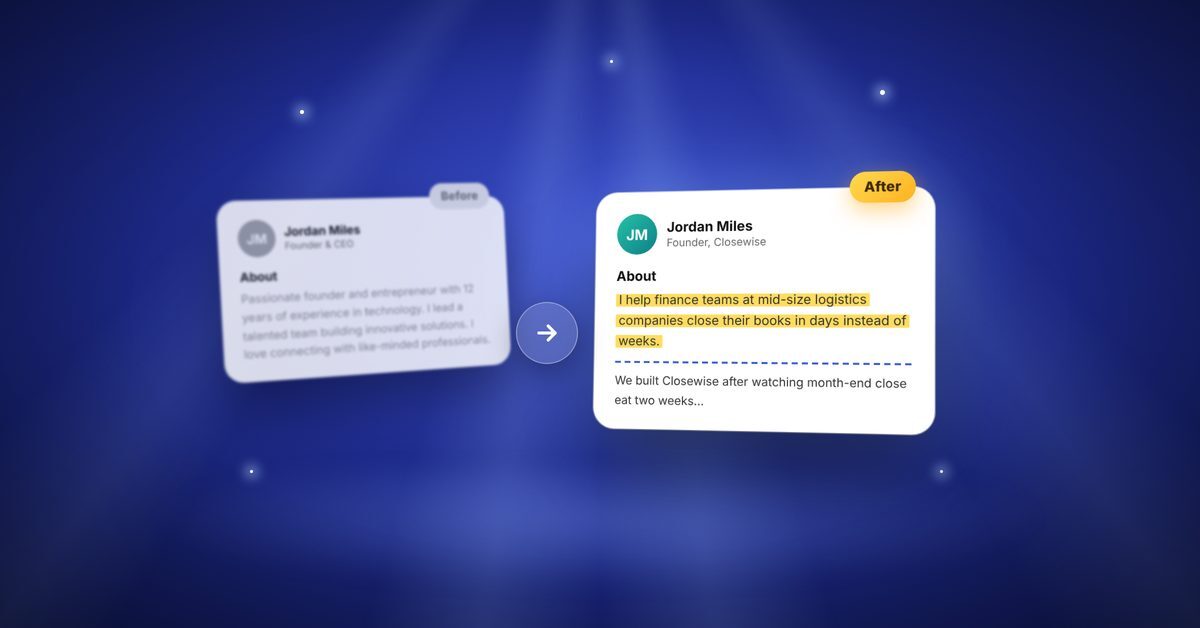
What does a good founder About section look like? Three before and after examples
The examples below are composite illustrations I wrote to show the pattern. They are not real customers, and the numbers are placeholders. Replace every number with one you can prove.
1. SaaS founder
Before: "Passionate founder and entrepreneur with 12 years of experience in technology. I lead a talented team building innovative solutions. I love connecting with like-minded professionals."
After: "I help finance teams at mid-size logistics companies close their books in days instead of weeks. We built [Product] after watching month-end close eat two weeks of every controller's calendar. Today [number] finance teams use it. If your close takes longer than [number] days, send me a message with the number and I will tell you where I would look first."
Why it works: the first sentence names the customer and the outcome. The proof is a count the founder can verify. The ending is a specific offer, not "let's connect."
2. MSP or cloud partner
Before: "We are a full-service managed services provider delivering end-to-end IT solutions to businesses of all sizes."
After: "We run IT and security for dental groups and medical practices with 5 to 40 locations. When a clinic's systems go down, patients are in the chair and nobody can pull a chart. We keep that from happening. [Number] practices, [number] year average client tenure, one phone number that a person answers. If you are comparing providers, message me and I will send our onboarding checklist."
Why it works: "dental groups and medical practices" is specific enough that the right buyer thinks "that is me." The pain is described as a scene, not a feature list. For more on how MSPs can stay visible without a marketing team, see social media for MSPs.
3. Professional firm partner
Before: "Partner at a regional firm. I provide tax, audit and advisory services to a diverse client base. Please feel free to reach out."
After: "I work with owner-managed manufacturers doing $10M to $100M in revenue, mostly in the year before they sell or hand the business to the next generation. Most owners come to me 6 months too late to fix what a buyer will find. I focus on [specific service]. I post a short note every [your cadence] on what buyers flag first. Message me before you sign a letter of intent, not after."
Why it works: it picks a moment in the client's life, not an industry label. It tells the reader when to call. Firms that want a posting routine to match can read LinkedIn content strategy for B2B firms.
How do you write your About section in 15 minutes?
Copy this into a blank document, replace the brackets, then cut anything that does not help a buyer decide.
- Line 1 (customer and outcome): "I help [specific customer] [get a specific result] without [the thing they dread]."
- Line 2 (the problem in their words): "Most [customer] I talk to are dealing with [problem as they would say it]."
- Line 3 (proof): "[Number or named result], including [customer type or named customer, with permission]."
- Short paragraph (how you work): two or three sentences on your approach and what makes it different.
- Short paragraph (why you): one sentence of background that earns trust, not a full history.
- Closing line (one next step): "[Message me / book a call / read this], and tell me [one detail] so I can reply with something useful."
Check the draft against four rules from the sources above: first person, no filler opener, short paragraphs with white space, and a first 220 characters that make sense on their own.
What mistakes make a founder's About section forgettable?
- Opening with a title. Your title is already in your headline.
- Using words buyers skip. LinkedIn's own guide calls out "strategic," "motivated" and "creative" as overused, and suggests showing the trait with an example (LinkedIn Talent Blog).
- Writing about the company, not the buyer. If "we" appears ten times and "you" appears never, rewrite it.
- Ending with nothing. A good About section with no next step wastes the reader's best moment of interest.
- Letting it go stale. If your About section says one thing and your last five posts say another, the buyer trusts neither.
How do your posts back up your About section?
An About section makes a promise. Your posts show you keep it. A buyer who reads "I help MSPs win clients in regulated industries" and then sees your last post from months ago will doubt the claim. A steady posting rhythm closes that gap. Social media for SaaS founders walks through how to keep posts consistent without writing every one by hand.
SocialPost.ai writes posts in your voice, designs the graphics, and holds everything for your approval before it goes live. You review, you approve, and your profile stays active. Start free at SocialPost.ai.
FAQ
How long should a LinkedIn About section be?
Long enough to answer a buyer's four questions and no longer. LinkedIn allows up to 2,600 characters, but a focused 800 to 1,500 characters usually holds everything a buyer needs. Put the most important claim in the first 220 characters because that is the part shown before "See more."
What should a founder write in the LinkedIn About section?
Say who you help, the problem you remove, one proof point and one next step. Skip your full career history. Add a short line on why you do this work only if it builds trust with your buyer.
Should I write the About section in first or third person?
First person. LinkedIn's own guidance recommends it, and it reads as a person talking, which is what a buyer wants before a call.
Is the LinkedIn About section the same as the Summary?
Yes. LinkedIn's guide describes the summary as the text box at the top of your profile, also called the About section. The names are used interchangeably.
Should I include keywords in my About section?
Yes, naturally. LinkedIn's guide suggests keywords for your top skills to help search on LinkedIn and Google, and Jobscan says recruiters search by titles, certifications and technical terms. For a founder, use the terms your buyers type: your customer type, your service and your industry.
Should I add a call to action?
Yes. End with one action that is easy to take, such as a message with one specific detail. Nutshell and Podawaa both recommend a clear call to action, and the buyer who reads to the end is your warmest visitor.
How often should I update my About section?
Review it whenever your offer, target customer or best proof point changes, and at least when you do a planning review. Then check that your recent posts match it.
Next step
Rewrite your first three lines today using the template. Then make sure the next ten posts prove what you wrote. Start free at SocialPost.ai and let your posts do the proving.